Key Takeaway
OpenAI’s acquisition of Weights.gg marks the end of low-value voice arbitrage. Indian IT firms must now pivot from providing 'human voices' to managing 'AI voice ecosystems' to protect their 25-30% operating margins.
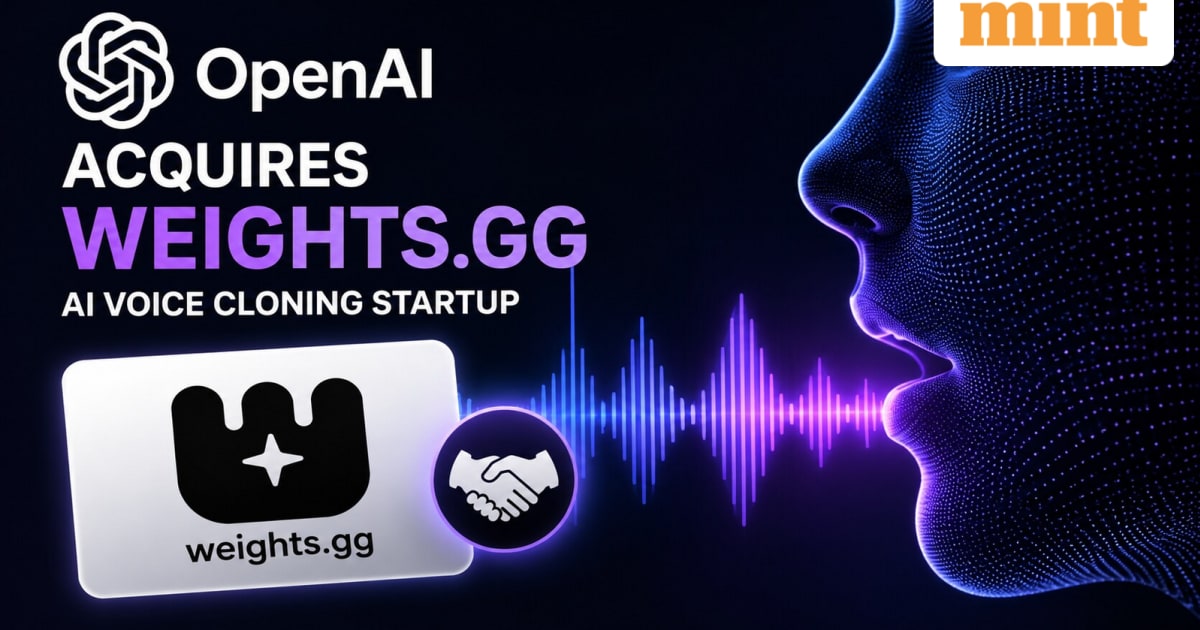
OpenAI has strategically acquired Weights.gg to dominate the multimodal AI landscape. This move threatens the traditional $250 billion Indian IT-BPM sector, forcing a rapid transition toward AI-augmented customer experiences and creating a new valuation paradigm for NSE-listed tech giants.
The Silent Coup: OpenAI’s Weights.gg Acquisition and the Multimodal Frontier
In a move that sent ripples through the global technology corridor, OpenAI recently finalized the acquisition of Weights.gg, a startup that gained notoriety and acclaim for its sophisticated AI voice cloning and training models. While the deal was executed with minimal fanfare, its implications are anything but quiet. For the Indian IT sector—the world’s back office—this acquisition is a clarion call. It signals that the era of text-based generative AI is evolving into a high-fidelity, multimodal reality where voice is the primary interface.
Weights.gg wasn't just another voice app; it was a community-driven powerhouse for 'voice models' that allowed users to replicate nuances, accents, and emotional inflections with startling accuracy. By absorbing this intellectual property, OpenAI is positioning GPT-4o to move beyond the 'robotic' cadence of traditional assistants. For investors in the National Stock Exchange (NSE) and Bombay Stock Exchange (BSE), the question is no longer if AI will disrupt the Business Process Outsourcing (BPO) sector, but how quickly Indian IT giants can weaponize this technology before it cannibalizes their revenue streams.
How will AI voice cloning impact Indian BPO jobs and IT services?
The Indian IT-BPM industry contributes nearly 7.5% to India’s GDP. Historically, this growth was fueled by cost arbitrage—hiring skilled Indian talent at a fraction of Western wages to handle customer support, sales, and technical troubleshooting. However, OpenAI’s move into high-fidelity voice synthesis effectively drives the cost of 'voice' to near zero. When an AI can handle a complex customer grievance with the empathy and accent of a human, the traditional $20-per-hour voice seat becomes a liability.
We are witnessing a structural pivot. Historical data from the 2010-2012 shift toward cloud computing showed that firms that didn't adapt their infrastructure saw their Price-to-Earnings (P/E) multiples contract by 15-20% within 24 months. Today, the stakes are higher. The integration of Weights.gg tech into the Microsoft-OpenAI ecosystem means that Fortune 500 companies can now deploy 'Digital Twins' of their best customer service agents. Indian IT firms like TCS and Infosys are now forced to move up the value chain, shifting from 'labor supply' to 'AI orchestration.'
Deep Market Impact: Connecting Silicon Valley Moves to Dalal Street
The acquisition is a net positive for the broader AI ecosystem but a 'Sell' signal for legacy-heavy operators. The immediate winners are Nvidia (providing the compute for these voice models) and Microsoft (the primary beneficiary of OpenAI’s breakthroughs). However, the secondary impact on Indian equities is nuanced. We expect a divergence in the IT sector: firms with robust AI/ML wings will see margin expansion as they replace human overhead with high-margin AI licenses, while mid-tier BPOs may face an existential crisis.
"The Weights.gg acquisition is the 'iPhone moment' for the voice industry. It turns a bespoke service into a scalable commodity." — WelthWest Research Desk
In 2022, when ChatGPT was first released, the Nifty IT index saw a temporary dip before rebounding as companies announced 'AI-first' strategies. This time, the market will demand proof of implementation. We anticipate that the next four quarters of earnings calls for Nifty IT companies will be dominated by 'Voice AI' integration metrics rather than 'Headcount' growth.
Stock-by-Stock Breakdown: The Winners and the Vulnerable
1. Tata Consultancy Services (TCS) - NSE: TCS
TCS remains the safest bet in this transition. With a market cap exceeding ₹15 lakh crore and a robust R&D budget, TCS has already begun integrating generative AI into its Cognix™ platform. The Weights.gg acquisition allows TCS to offer 'Hyper-Personalized Voice Agents' to its retail and banking clients. Expect TCS to maintain its premium P/E ratio (currently around 28-30x) as it pivots to high-margin AI consulting.
2. Infosys - NSE: INFY
Infosys has been aggressive with its Topaz AI offering. The acquisition of Weights.gg tech by OpenAI (a partner via Microsoft) directly benefits Infosys’s ability to automate its massive customer experience (CX) contracts. However, with a significant portion of revenue still tied to legacy maintenance, the transition period may see some volatility. Watch for their operating margins; if they stay above 20%, the AI pivot is working.
3. Tata Elxsi - NSE: TATAELXSI
As a specialist in design and technology, Tata Elxsi is a primary winner. Their work in the automotive and healthcare sectors requires high-fidelity voice interfaces (e.g., in-car assistants, medical devices). The commoditization of voice cloning tech allows them to build more complex, emotion-aware systems for global OEMs. They are a high-growth play with a P/E often exceeding 50x, reflecting their niche dominance.
4. Happiest Minds Technologies - NSE: HAPPSTMNDS
This is a pure-play digital transformation firm. Unlike the giants, Happiest Minds doesn't have a 'legacy tail' to drag it down. They can implement OpenAI’s new voice capabilities faster than their larger peers. For investors, this is a high-beta play on the AI voice revolution.
5. LTIMindtree - NSE: LTIM
The merger of LTI and Mindtree created a formidable player in the mid-to-large cap space. They are currently trading at an attractive valuation compared to TCS. Their focus on 'Experience Engineering' makes them a direct beneficiary of multimodal AI. If they can capture the Cybersecurity aspect of voice—detecting deepfakes—they could see a significant re-rating.
Which Indian stocks will benefit most from OpenAI's expansion?
Beyond the direct IT services players, the Cybersecurity sector in India is an overlooked beneficiary. As voice cloning becomes accessible, the risk of 'Voice Phishing' or 'Vishing' skyrockets. Companies like Quick Heal (NSE: QUICKHEAL) or specialized AI firms focusing on deepfake detection will see increased demand from the banking and financial services (BFSI) sector. Furthermore, data center providers like Netweb Technologies (NSE: NETWEB) will benefit from the localized compute power required to run these intensive voice models for Indian enterprises.
Expert Perspective: The Bull vs. Bear Case
The Bull Case: Analysts argue that AI voice cloning will lead to a 'Margin Explosion.' By replacing 50% of a call center's staff with AI agents that cost 90% less to operate, Indian IT firms can double their net profit margins on those specific contracts. The narrative shifts from 'Volume' to 'Value.'
The Bear Case: Skeptics point to the 'Revenue Contraction.' If a project that previously required 500 people now requires only 50 AI orchestrators, the total contract value (TCV) will shrink. Unless Indian IT firms can find new problems to solve, the shrinking top line will lead to a de-rating of the entire sector. Furthermore, the regulatory risk of deepfake technology could lead to sudden, restrictive bans that disrupt business continuity.
Actionable Investor Playbook: Navigating the Voice AI Wave
- The Core Portfolio: Maintain exposure to TCS and HCLTech for stability. These firms have the balance sheets to acquire their way into AI dominance if they fall behind.
- The Growth Pocket: Accumulate Tata Elxsi on dips. Their involvement in the 'Internet of Things' (IoT) and voice-enabled devices makes them a structural winner in a multimodal world.
- The Entry Point: Look for Nifty IT to trade at a 10-15% discount to its 5-year average P/E before going 'All-In.' The market is currently pricing in some AI disruption, but the full impact of voice synthesis isn't fully baked in.
- Time Horizon: This is a 3-5 year play. Avoid short-term 'noise' from quarterly fluctuations and focus on the adoption rate of AI platforms like Infosys Topaz or Wipro ai360.
Risk Matrix: What Could Go Wrong?
- Regulatory Crackdown (Probability: High): Global governments are terrified of deepfakes. A sudden 'Voice AI Tax' or restrictive licensing could stall OpenAI's integration and the revenue Indian IT expects from it.
- Ethical Backlash (Probability: Medium): If voice identity theft becomes rampant, consumer trust in voice interfaces will collapse, forcing a return to human-only support.
- Compute Costs (Probability: Low): If the cost of running high-fidelity voice models doesn't scale down, the ROI for Indian BPOs to switch from humans to AI might not materialize as quickly as predicted.
What to Watch Next: Catalysts on the Horizon
Investors should keep a close eye on the Microsoft Build Conference and OpenAI’s next major update (rumored to be GPT-5). Any mention of 'Voice API' pricing will be the primary driver for Indian IT stock sentiment. Additionally, watch for the RBI’s guidelines on AI in Banking; if the Indian regulator greenlights AI voice for KYC and customer support, it will trigger a massive domestic bull run for the tech sector. The upcoming Q3 and Q4 earnings calls will be the 'moment of truth' for how much of this tech is already being deployed on the ground in cities like Bengaluru and Hyderabad.
Disclaimer: This content is generated by WelthWest Research Desk based on publicly available reports and is for informational purposes only. It does not constitute financial advice, investment recommendations, or an offer to buy or sell securities. Always consult a qualified financial advisor before making investment decisions.