Key Takeaway
The global investment mandate has shifted from 'Emerging Market Growth' to 'AI-Driven Productivity.' As FIIs reallocate capital to the US, Taiwan, and South Korea, Indian IT exporters face a structural de-rating unless they prove AI-led margin expansion.
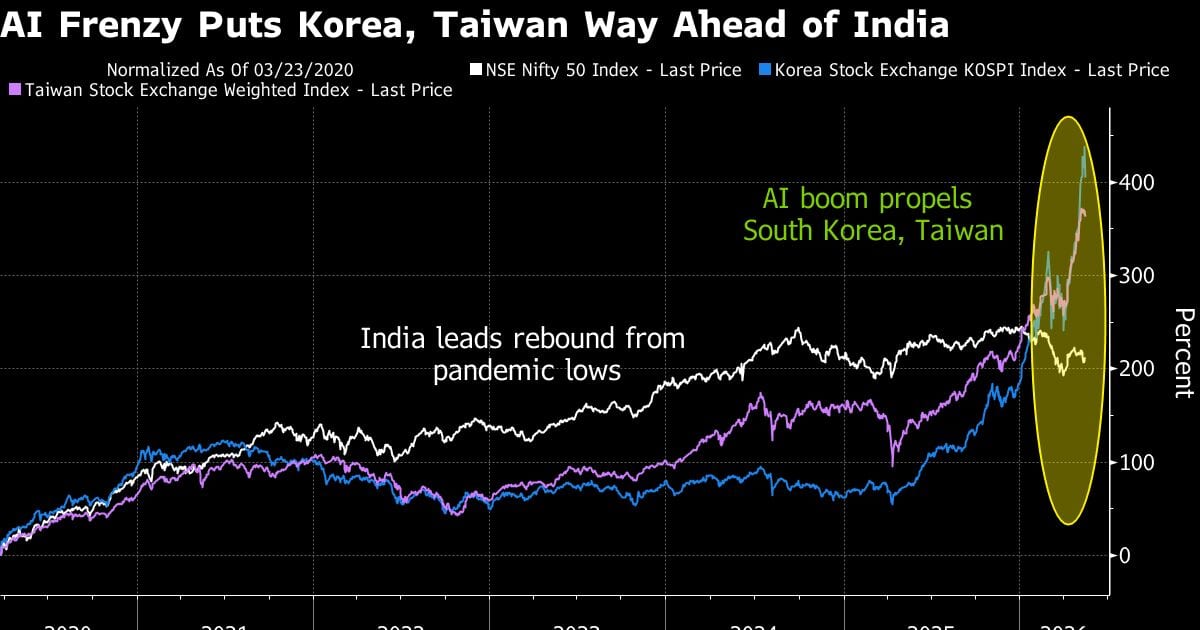
A seismic shift in global capital is underway as Foreign Institutional Investors (FIIs) pivot away from India's premium-valuation equities toward the AI-centric infrastructure of the US, Taiwan, and South Korea. This article analyzes the liquidity headwinds facing the Nifty IT index and the potential for a sustained valuation compression in India's technology sector.
The Great Capital Rotation: Why Indian Markets Are Losing Their Luster
For the past decade, the 'India Story' was the darling of global emerging market funds. Driven by favorable demographics, a stable regulatory environment, and consistent double-digit earnings growth, India commanded a valuation premium that dwarfed its regional peers. However, the emergence of the Artificial Intelligence (AI) supercycle has fundamentally altered the global asset allocation playbook. We are currently witnessing a massive rotation of capital away from traditional software services toward the 'picks and shovels' of the AI revolution: semiconductor manufacturing, high-bandwidth memory (HBM) production, and hyperscale cloud infrastructure.
This is not merely a transient correction; it is a structural reallocation. Investors are no longer hunting for regional growth proxies; they are hunting for specific exposure to the NVIDIA-led productivity boom. With capital being pulled into the US and the 'Silicon Shield' economies of Taiwan and South Korea, the Indian market—specifically the IT services sector—is facing a liquidity vacuum that threatens to compress P/E ratios that have sat at historically elevated levels for years.
Why Is AI Triggering a Sell-Off in Indian IT?
The core issue lies in the business model of India’s IT giants. Historically, companies like TCS and Infosys thrived on labor-arbitrage and digital transformation projects. Today, the global enterprise spend is shifting toward generative AI integration, which requires specialized hardware and proprietary AI stacks—areas where Indian firms have historically lacked a 'moat.' As FIIs consolidate portfolios to gain exposure to companies like TSMC or SK Hynix, they are liquidating positions in sectors that are perceived as 'AI-neutral' or 'AI-threatened.'
Stock-by-Stock Analysis: The Impact on NSE IT Leaders
- TCS (TATA CONSULTANCY SERVICES): Trading at a trailing P/E of ~30x, TCS remains the industry benchmark. However, institutional investors are questioning whether TCS’s 'TCS Cognix' suite can compete with the rapid deployment of autonomous AI agents. If growth remains in the mid-single digits, a de-rating to a 22-24x multiple is statistically probable.
- INFY (INFOSYS): Infosys has invested heavily in 'Topaz,' its AI-first offering. Despite this, the market is discounting its revenue potential due to the high cost of implementation. FIIs are currently viewing INFY as a 'wait-and-see' stock, leading to stagnant price action despite strong cash flows.
- HCLTECH (HCL TECHNOLOGIES): HCL’s focus on engineering services makes it more resilient, yet it remains tethered to the broader Nifty IT index. Any further capital outflows from the tech sector will likely drag HCLTECH down, regardless of its superior operational efficiency.
- WIPRO (WIPRO) & TECHM (TECH MAHINDRA): These companies are the most vulnerable. With lower margins compared to their peers, they lack the 'fortress balance sheets' required to weather a sustained period of valuation compression. Tech Mahindra’s exposure to communication service providers—a sector currently under pressure—adds an additional layer of risk.
How Will RBI Interest Rate Policy Influence This Trend?
While the market focuses on AI, the Reserve Bank of India’s (RBI) interest rate trajectory remains a critical variable. If the RBI maintains higher-for-longer rates to defend the Rupee against a strengthening Dollar (driven by US AI-led capital inflows), the cost of capital for Indian firms will rise. This creates a double-whammy: a flight of foreign liquidity combined with domestic margin compression due to higher debt-servicing costs.
The Contrarian View: Are We Overreacting?
Bulls argue that the AI boom is a 'rising tide that lifts all boats.' They contend that as global firms adopt AI, they will eventually look to Indian IT services to manage the complex, labor-intensive implementation of these models. If Indian IT firms successfully pivot from 'legacy maintenance' to 'AI-managed services,' we could see a massive earnings surprise. However, the data currently suggests this is a long-term prospect, not a short-term catalyst for stock price appreciation.
Actionable Investor Playbook: Navigating the Rotation
Investors should adopt a defensive stance toward the IT sector until there is clear evidence of 'AI-margin expansion' in quarterly filings.
- SELL/REDUCE: High-P/E mid-cap IT stocks that lack a proprietary AI product suite.
- HOLD: Large-cap incumbents like TCS and INFY for dividend yields, but expect low capital appreciation in the 6-12 month horizon.
- WATCH: Small-cap firms that are niche players in AI data labeling or specialized software testing, as they may become acquisition targets for global tech giants.
Risk Matrix: Assessing the Capital Flight
| Risk Factor | Probability | Impact |
|---|---|---|
| Persistent FII Outflows | High | Severe |
| Rupee Depreciation (>85/USD) | Medium | High |
| Sustained De-rating of Nifty IT | High | Medium |
What to Watch Next
Keep a close eye on upcoming quarterly earnings calls specifically for 'AI-led revenue contribution' metrics. If companies like Infosys or HCLTECH report that less than 5% of their revenue is tied to generative AI, the market will likely penalize their valuations further. Additionally, monitor the FII flow data released by NSDL; a sustained three-month net selling trend in the IT sector will be the definitive signal that the 'AI Rotation' is in its terminal phase.
Disclaimer: This content is generated by WelthWest Research Desk based on publicly available reports and is for informational purposes only. It does not constitute financial advice, investment recommendations, or an offer to buy or sell securities. Always consult a qualified financial advisor before making investment decisions.