Key Takeaway
While XRP's immediate price action is contained, its consolidation reflects underlying crypto market jitters. This sentiment could subtly dampen investor appetite for high-risk Indian equities, particularly in emerging tech and speculative sectors.
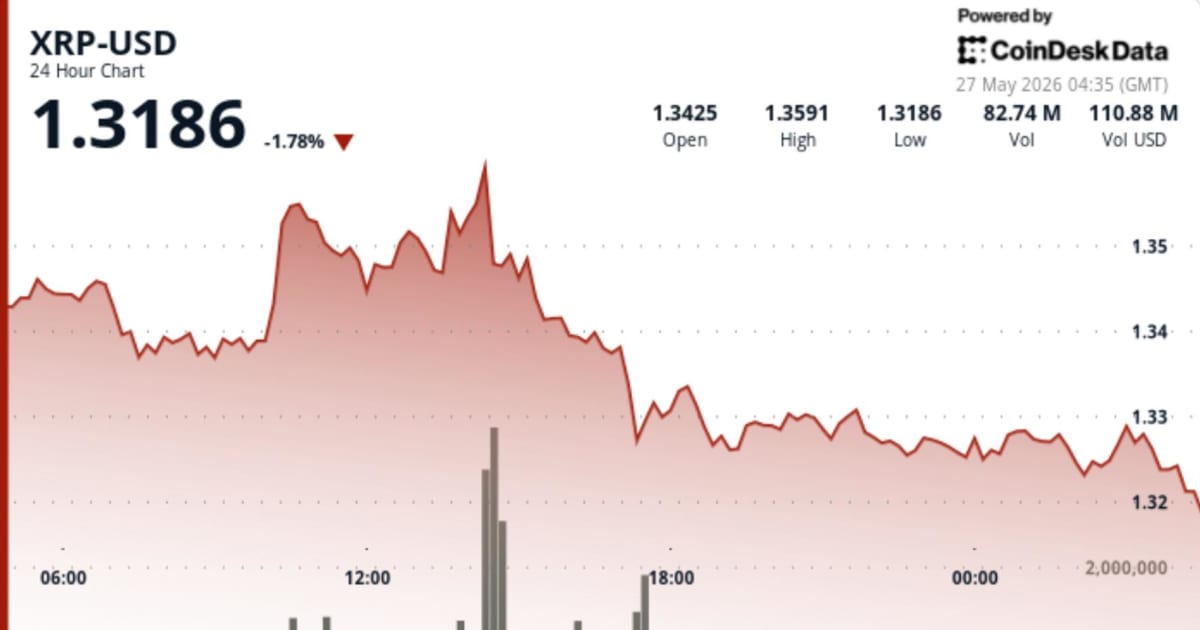
XRP's price has entered a period of quiet consolidation, a signal of broader cryptocurrency market indecision. This analysis delves into the indirect ramifications for the Indian stock market, highlighting how such global crypto sentiment can influence investor behavior towards speculative and tech-focused Indian companies. We identify specific NSE/BSE stocks poised to feel this ripple effect.
XRP Price Consolidation: A Subtle Signal for Indian Speculative Investments
The cryptocurrency market, often characterized by its dramatic price swings and rapid sentiment shifts, is currently observing a period of relative calm for XRP. While the direct correlation between XRP's price movements and the Indian equity market is historically weak, this specific phase of consolidation near the $1.32 mark is far from inconsequential. It signifies a broader market sentiment of caution and a narrowing trading range, prompting us at WelthWest Research Desk to investigate its potential, albeit indirect, influence on Indian investors' risk appetite, particularly concerning speculative assets and emerging technology stocks.
This period of XRP's price stability, following previous surges, isn't indicative of a burgeoning bull run but rather a pause for breath. The failure to sustain a breakout above key resistance levels suggests that the speculative fervor has momentarily subsided, and traders are reassessing the underlying fundamentals and regulatory landscape. This inherent uncertainty within the global crypto sphere can create a psychological ripple effect, making investors worldwide, including those in India, more risk-averse towards other high-volatility asset classes. Understanding this dynamic is crucial for navigating the nuanced interplay between global digital asset trends and domestic market behavior.
Why This XRP Consolidation Matters for Indian Investors Now
The current scenario with XRP, where its price is confined within an increasingly constricted trading range, acts as a barometer for overall cryptocurrency market sentiment. While XRP itself might not have substantial direct investment flows from India compared to Bitcoin or Ethereum, its price behavior reflects the collective mood of digital asset investors. When major cryptocurrencies exhibit indecision or consolidation, it often correlates with a broader hesitancy to engage in highly speculative ventures. This sentiment can spill over, influencing how Indian retail and institutional investors perceive risk in their domestic markets.
The regulatory environment for cryptocurrencies remains a significant overhang globally, and India is no exception. While India has moved towards taxation of crypto assets, a definitive framework for their integration and regulation is still evolving. This ongoing ambiguity means that any significant price action, or lack thereof, in globally prominent digital assets like XRP can serve as a proxy for the perceived risks associated with unregulated or loosely regulated financial instruments. Therefore, even a seemingly contained XRP price movement can subtly impact the broader risk-on/risk-off sentiment that guides investment decisions in India's burgeoning tech and speculative stock segments.
Deep Market Impact Analysis: Connecting Crypto Sentiment to Indian Equities
The impact of cryptocurrency market sentiment on Indian equities is not direct, but rather a function of investor psychology and capital allocation. When cryptocurrencies are experiencing sharp declines or prolonged periods of uncertainty, as suggested by XRP's narrowing range, it can lead to a general 'risk-off' sentiment. This means investors tend to pull back from assets perceived as higher risk, which often includes early-stage technology companies, speculative growth stocks, and even certain mid-cap companies with innovative but unproven business models listed on the NSE and BSE.
Historically, periods of significant crypto market downturns have often coincided with cautious trading in emerging market equities. For instance, during the major crypto correction in early 2022, the Nifty 50 experienced a period of heightened volatility and a slight downturn, with speculative growth stocks underperforming the broader index. While not a direct causal link, the underlying investor sentiment – a desire for safety over growth – is a shared driver. Companies with high P/E ratios and significant reliance on future growth projections, common in the Indian tech sector, are particularly vulnerable to shifts in this sentiment. A market capitalization weighted index like the Nifty 50 might show resilience, but the mid-cap and small-cap indices, which house many of these speculative plays, tend to be more sensitive to such global risk-off waves.
The sector most directly, albeit indirectly, affected is the 'emerging technology' or 'new economy' sector within Indian stock exchanges. This includes companies involved in digital payments, e-commerce, fintech, and software-as-a-service (SaaS), many of which have seen substantial investor interest fueled by venture capital and a belief in digital transformation. If global crypto sentiment turns sour, it can lead to a recalibration of risk premiums applied to these Indian companies. For example, a company like Zomato (NSE: ZOMATO), despite its strong revenue growth potential, could see its valuation scrutinized more intensely if the broader risk appetite wanes due to global speculative asset instability.
Who Benefits and Who Suffers in the Indian Market?
In this nuanced scenario, the direct 'winners' are scarce. However, investors who prioritize capital preservation might indirectly benefit by avoiding the potential fallout in speculative assets. Companies with strong balance sheets, consistent profitability, and established market positions, often found in traditional sectors like banking (e.g., HDFC Bank, NSE: HDFCBANK) or essential consumer goods (e.g., Hindustan Unilever, NSE: HUL), tend to be more resilient and could see relative outperformance as capital seeks safer havens.
Conversely, the 'losers' are likely to be companies with significant exposure to speculative digital assets, either directly through treasury holdings or indirectly through business models that rely heavily on crypto-related infrastructure or funding. This also extends to companies whose valuations are predominantly driven by speculative investor interest rather than immediate profitability. For instance, companies that have recently raised capital through Initial Public Offerings (IPOs) at high valuations and are yet to prove their business models consistently could face increased pressure if the market sentiment sours. The impact is amplified for firms that have seen their market capitalization swell based on narrative rather than tangible, sustainable revenue streams.
Stock-by-Stock Breakdown: Identifying Potential Impacts on NSE/BSE
While no Indian stock is directly tied to XRP's price, the sentiment shift can affect specific companies. We've identified a few key tickers whose valuations and investor sentiment might be indirectly influenced by a sustained period of crypto market caution.
- One 97 Communications (Paytm) (NSE: PAYTM): As a prominent fintech player, Paytm's valuation is sensitive to overall investor sentiment towards digital financial services and speculative growth. While its revenue figures are growing (e.g., reported revenue of ₹1,650 crore for Q4 FY23), its path to profitability remains a key focus. A global risk-off sentiment, potentially triggered by crypto jitters, could lead to increased scrutiny of its high growth, high expenditure model, impacting its already volatile stock price. Sector peers like PB Fintech (NSE: POLICYB) might face similar headwinds.
- Zomato Limited (NSE: ZOMATO): This food delivery giant, with its significant market capitalization and focus on aggressive expansion, operates in a growth-oriented sector. While it has demonstrated revenue growth (e.g., Q4 FY23 revenue at ₹2,056 crore), its market valuation is heavily dependent on future earnings potential. If the speculative appetite diminishes globally, investors might demand a higher risk premium, potentially affecting Zomato's stock, especially if it fails to meet aggressive growth targets.
- Nazara Technologies (NSE: NAZARA): This gaming and sports media company has been a darling of the speculative growth segment. Its business model, while innovative, relies on expanding user bases and future monetization. A global pullback from speculative tech could disproportionately affect stocks like Nazara, whose P/E ratios have often been elevated, reflecting high growth expectations. Any sustained crypto market weakness could amplify the pressure on its stock.
- Affle India Limited (NSE: AFFLE): Specializing in marketing technology and programmatic advertising, Affle India operates in a competitive digital space where investor sentiment can be a significant driver. Its strong revenue growth has been a key positive, but like other tech platforms, its valuation is sensitive to broader market risk appetite. A cautious global outlook, influenced by crypto uncertainty, could lead to a reassessment of its growth premium.
- Nykaa (FSN E-Commerce Ventures Ltd.) (NSE: NYKAA): As an e-commerce platform focused on beauty and lifestyle, Nykaa's valuation is tied to its growth trajectory and market share expansion. While it has shown revenue increases (e.g., FY23 revenue of ₹5,118 crore), its profitability has been a point of discussion. A general cooling of speculative investment sentiment could lead investors to question its premium valuation, particularly if growth rates moderate.
Expert Perspective: Bulls vs. Bears on Crypto Sentiment's Indian Impact
Bullish Argument: Bulls would argue that the XRP consolidation is a minor event within the vast crypto universe and has negligible direct impact on the fundamentally strong Indian equity market. They would point to the robust growth of Indian companies, the increasing institutional adoption of Indian equities, and the Reserve Bank of India's (RBI) prudent monetary policy as drivers that are far more significant than the price action of a single altcoin. They might highlight that companies like Paytm or Zomato have unique Indian growth stories that are insulated from global crypto volatility. Furthermore, they could emphasize that any dip in speculative tech stocks presents a buying opportunity for long-term investors focused on India's digital transformation narrative.
Bearish Argument: Bears, conversely, would contend that the XRP situation is symptomatic of a broader, underlying unease in the speculative asset class. They would argue that capital is fungible, and a sustained downturn or uncertainty in cryptocurrencies can lead to a general de-risking by investors, who then pull funds from other perceived high-risk assets, including Indian tech stocks. They might draw parallels to past global financial crises where contagion effects spread rapidly. Bears would also point to the high valuations of many Indian tech stocks, making them particularly vulnerable to any shift in investor sentiment away from growth and towards value and safety. They would emphasize that while direct links are absent, the psychological impact on investor confidence is real and can manifest as selling pressure on speculative Indian equities.
Actionable Investor Playbook: Navigating the Current Market Climate
Given the current neutral sentiment and low impact assessment, a balanced approach is recommended. However, vigilance is key.
- Diversification is Paramount: Ensure your portfolio is well-diversified across sectors and asset classes. Reduce over-allocation to highly speculative tech stocks if they constitute a significant portion of your holdings.
- Focus on Quality: Prioritize companies with strong fundamentals, consistent profitability, manageable debt, and clear competitive advantages. Look for stocks with reasonable P/E ratios relative to their growth prospects. Examples include established banking giants like ICICI Bank (NSE: ICICIBANK) or ITC (NSE: ITC) in the consumer staples sector, which tend to be more defensive.
- Monitor Emerging Tech Valuations: For investors keen on the tech sector, adopt a patient approach. Instead of chasing high-flying IPOs or momentum stocks, look for established players with proven business models and attractive entry points. Consider dollar-cost averaging into quality tech stocks like Infosys (NSE: INFY) or Wipro (NSE: WIPRO) during periods of broader market correction, rather than trying to time speculative bounces.
- Watch for Contagion: Keep a close eye on global crypto market movements. A significant breakdown in major cryptocurrencies could signal a broader risk aversion that might warrant a temporary reduction in exposure to speculative Indian equities.
- Entry Points: For speculative tech stocks, consider waiting for confirmation of stabilization or a clear upward trend. If you are already invested, re-evaluate your position based on the company's fundamentals rather than just market sentiment. For defensive assets, consider accumulating on dips.
- Time Horizons: This cautious sentiment is likely to be short-to-medium term. Long-term investors in India's growth story should see this as an opportunity to rebalance and potentially acquire quality assets at more attractive valuations, rather than a reason to exit entirely.
Risk Matrix: Assessing Potential Downside Scenarios
While the immediate impact is assessed as low, several risks could escalate the situation:
- Escalating Global Regulatory Crackdown (Probability: Medium): Increased and coordinated regulatory actions against cryptocurrencies in major economies could trigger a widespread sell-off, leading to significant contagion effects on global speculative investments.
- Major Cryptocurrency Exchange Collapse (Probability: Low): The failure of a large, systemically important cryptocurrency exchange could lead to a loss of confidence and a sharp, rapid decline across the entire digital asset market, amplifying risk aversion globally.
- Sustained XRP Price Decline (Probability: Medium): A prolonged and significant downtrend in XRP's price, especially if accompanied by negative fundamental news or legal developments, could serve as a persistent negative signal for the broader crypto market, dampening investor sentiment towards riskier assets worldwide.
What to Watch Next: Upcoming Catalysts and Data Points
Several factors will shape the future outlook for both cryptocurrencies and their indirect influence on Indian markets:
- Regulatory Announcements: Any significant updates from global regulators (e.g., SEC in the US, European Union) regarding cryptocurrency regulation will be crucial. In India, pronouncements from the RBI or the Ministry of Finance on the digital asset landscape will also be closely monitored.
- Macroeconomic Data: Inflation figures, interest rate decisions from major central banks (especially the US Federal Reserve), and GDP growth data will continue to dictate the broader risk appetite for all asset classes.
- Corporate Earnings: The upcoming quarterly earnings reports from Indian tech and growth companies will be critical in determining whether their valuations are justified by actual performance, especially in a potentially risk-averse environment.
- XRP Legal Developments: Ongoing legal proceedings involving Ripple and the SEC remain a key catalyst for XRP's price and, by extension, sentiment in the broader crypto space.
By understanding these interconnected dynamics, investors can better position themselves to navigate the complexities of the global financial landscape and its subtle but significant implications for the Indian stock market.
Disclaimer: This content is generated by WelthWest Research Desk based on publicly available reports and is for informational purposes only. It does not constitute financial advice, investment recommendations, or an offer to buy or sell securities. Always consult a qualified financial advisor before making investment decisions.